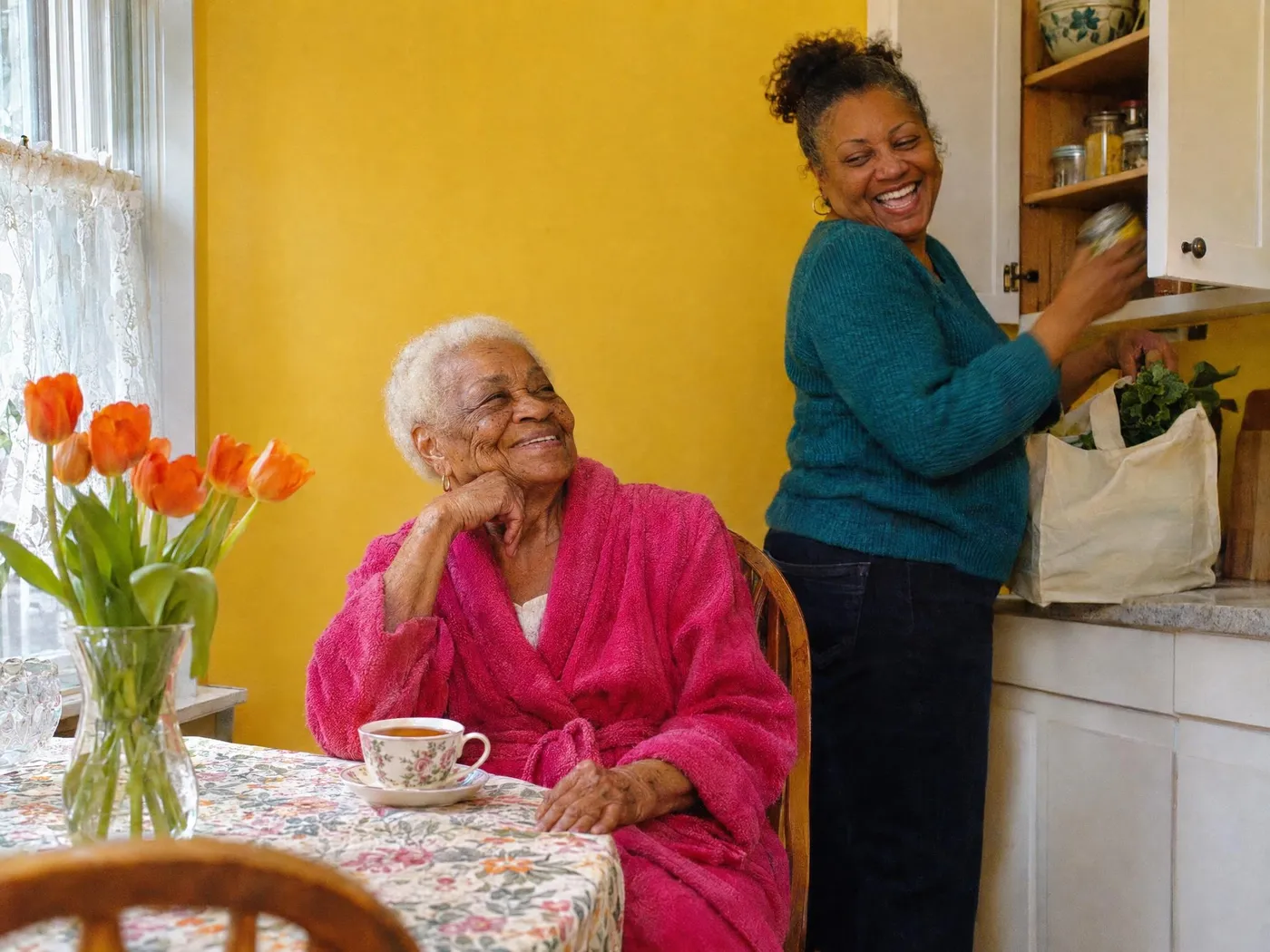
Get the plan in writing before she leaves the hospital. On day two or three, make your own call: how she feels, her pills, her appointments, her help at home. Then let Betsy talk with her every day and tell you the same day if she mentions a fall or an illness. $2 a day, billed $60 a month.
The short version
- Betsy talks with her every day, and you hear the same day if she mentions a fall or an illness.
- Before she leaves, say “She lives alone” out loud, and get everything in writing.
- While she’s there, ask every day: “Is she an inpatient or an outpatient?”
- On day two or three, make the call: how she feels, her pills, her appointments, her help at home, and who she phones at 2 a.m.
- Within two business days, call her regular doctor’s office and ask when her visit is.
Why do the first two weeks matter so much?
Because this is when the plan meets the house. The Agency for Healthcare Research and Quality counted 16.0 readmissions within 30 days for every 100 hospital stays among Medicare patients 65 and older in 2020. The Centers for Disease Control and Prevention (2026) says “Falling once doubles your chances of falling again.” Neither number means it will happen to her. They mean these weeks deserve a plan, because the hospital’s was written for a patient, and she’s going home to a house: stairs, a bathroom at the far end of the hall, and nobody there at three in the morning.
What do you ask before she leaves?
- Say it out loud. Tell the discharge planner: “She lives alone. Nobody will be in the house tonight.” The Family Caregiver Alliance says it is “extremely important” to tell discharge staff your limits, and “reasonable to ask” them to slow down if you feel rushed.
- Ask about her status, every day she’s there. Medicare says to: “Is she an inpatient or an outpatient?” A night on observation counts as outpatient, and her status can affect whether Medicare covers a skilled nursing stay afterward.
- Get your name in her record. AARP says the CARE Act is enacted in 44 states and territories. It requires hospitals to record your name, tell you when she’s being discharged and teach you any medical tasks you’ll do at home. Ask to be put down.
- Work through Medicare’s checklist. Who to call with questions. Complications to watch for. A drug list showing what’s new, what changed and what stopped. Who delivers the walker. Instructions in writing.
- Do the errands first. Medicare’s checklist says to get prescriptions and food before she’s discharged, and it’s right.
- If it feels too soon, ask for the notice. Staff should give her the “Important Message from Medicare,” which explains her right to a fast appeal. If you don’t get it, the checklist says to ask.
What do you do the first night?
Walk the route she’ll take at three in the morning, in the dark, with the walker: bed to bathroom and back. A hospital in Pennsylvania learned on a follow-up call why a patient wasn’t taking her water pill. The Agency for Healthcare Research and Quality quotes the answer in its discharge toolkit.
“because the bathroom was on the other side of her house.”
A hospital in Pennsylvania, in AHRQ’s discharge toolkit
They got her a commode, and she stayed home. So roll up the rug by the bed and put a light on the route. Put a phone where she can reach it from the bed. Leave a week of food she can lift, at counter height. Tape the list of complications to the fridge. Tell the neighbor with the key that she’s home.
What do you say on day two or three?
AHRQ’s toolkit says patients should be “called 2 to 3 days after discharge” by clinical staff, and that the call covers five things. Ask whether her hospital does this. Then make your own, in a daughter’s words. Give it an evening: AHRQ’s own calls run about 20 to 60 minutes.
| AHRQ’s five | What you say | What you’re listening for |
|---|---|---|
| Health | “What did they tell you it was? Better or worse than when you came home?” | Whether she can say why she was there |
| Medicines | “Get the bottles. Read me each one. What’s it for, and when do you take it?” | A stopped pill still in the pillbox; a prescription never filled |
| Appointments | “When’s the doctor? Who’s driving?” | A date, a time and a name |
| Help at home | “Did the walker come? Has anyone from the agency called?” | Anything promised that hasn’t come |
| If something goes wrong | “If you feel worse at 2 a.m., who do you call?” | A number she can actually find |
Ask her to say it back in her own words. AHRQ calls that teach-back, and it is “not a test of the patient’s knowledge.” It’s a test of how well she was told. If something doesn’t match, take it to the number on her discharge papers that same day.
What is the call to her doctor’s office?
Within two business days, call her regular doctor. Medicare pays practices for transitional care management: contact with her or a family member within two business days of discharge, a visit within 7 or 14 days, and her medicines reconciled by that visit. The office may not know she’s home yet, so tell them.
My mother came home from St. Mary’s on Monday. She lives alone. Is she set up for transitional care management, and when is her visit?
Who pays for help at home?
Medicare covers certain home health services if she’s eligible, and for those, “You pay nothing,” though other costs may apply. A provider has to see her and order it, and she has to count as “homebound,” meaning leaving home is hard for her. It is part-time. Medicare doesn’t pay for 24-hour-a-day care, home meal delivery, or shopping and cleaning unrelated to her care plan. So line up the rest early. Meals on Wheels says most providers require an application and that demand is “higher than usual,” so call before she’s home, and ask her health plan whether it covers meals after a hospital stay. The Eldercare Locator, 1-800-677-1116, can tell you who serves her county.
Who hears from her every day?
Right after a hospital stay, somebody should hear from her every day. There are two jobs in that. One is the conversation: she has spent days being told things, and somebody should ask her about something else. The other is yours, or a sibling’s: one named person expects to hear from her every morning, by two rings, a text or a short call, and knows what to do if it doesn’t come. How to check on an older parent has the steps. If a fall is the worry, medical alert or a daily call is the next read.
What does this look like for one family?
Picture one family. Pat is 81 and lives alone in Sarasota. Her daughter Kim flies in from Chicago for the discharge. Betsy calls Pat at eleven.
| Day | What happened |
|---|---|
| Day 0 | Pat comes home after pneumonia. Kim fills the prescriptions on the way. |
| Night 1 | Kim walks the route to the bathroom with the walker. One rug goes. |
| Day 2 | Pat reads her bottles aloud. She’s taking the old water pill and the new one. Kim calls the doctor’s office. |
| Day 3 | A visit is set for day 9. Kim flies home. Pat rings her twice each morning. |
| Day 5 | Pat tells Betsy she got dizzy at the sink. Kim has her mother’s own words that afternoon, and calls the office. |
| Day 6 | The doctor moves the visit up and sees her. |
| Day 14 | Pat walks to the mailbox. Sunday’s text: ask her about the summer she sold brushes door to door. |
The discharge-day checklist
- The name and number of someone to call with questions, day and night
- Written discharge instructions she can read
- The drug list: what’s new, what changed, what stopped
- Complications to watch for, taped to the fridge
- Inpatient or outpatient: asked, and written down
- Your name in her record
- Walker or other equipment: who delivers it, and when
- Prescriptions filled before she walks in the door
- The first appointment: date, time, who drives
- The home health agency’s name and start date, if she has one
- A week of food she can reach and lift
- The route from bed to bathroom cleared and lit, with a phone by the bed
- The neighbor with the key told she’s home
- The person who expects to hear from her every morning for two weeks
Where Betsy fits
These are the two weeks when a phone that rings counts for a lot. Betsy calls Mom every day at the hour Mom picks, from the same local number, in the same voice, and talks with her for about ten minutes about something other than her discharge papers. She remembers every conversation, so each call starts where the last one ended, and Mom never has to tell it twice. There is nothing to install or learn, which is the right amount for someone just home from the hospital. Mom can call her any time, and Betsy knows who it is.
If Mom mentions a fall, an injury or an illness, someone after her money, or anything she wants passed along, you hear the same day, in her own words, and Betsy tells her when she does. Everything else stays hers, and on Sunday you get one text with one line and one story.
She is a computer voice and says so on every call. She isn’t a nurse or an emergency service, and she gives no medical advice, so the doctor’s number stays on the fridge. $2 a day, billed $60 a month, on any phone. Say “stop” and it stops, and unused months are refunded. See how it starts, or read what Betsy is.
Questions people ask
Discharged home alone, elderly parent: what to do?
Tell the discharge planner she lives alone, before she leaves. Get written instructions, a drug list and the name of someone to call. Fill prescriptions on the way home, walk the route to the bathroom, and make your own follow-up call on day two or three.
After Mom's fall, how do I check on her living alone at home?
Talk with her every day, expect to hear from her every morning, and get someone into the house this week. Tell her doctor about the fall. The CDC says falling once doubles the chances of falling again.
Who is supposed to call her after she gets home?
Ask before she leaves. AHRQ recommends a call from clinical staff two or three days after discharge, and Medicare pays practices to make contact within two business days. Find out who will call, and make your own call regardless.
Does Medicare pay for someone to help at home after a hospital stay?
It covers certain part-time home health services if she is eligible and a provider orders them, and she pays nothing for covered services. It doesn’t pay for 24-hour care, home meal delivery, or shopping and cleaning unrelated to her care plan.
What does Betsy do if she mentions a fall?
She passes it along, and she tells Mom she is doing it. The family hears the same day, in Mom’s own words.
Sources
- Agency for Healthcare Research and Quality, Tool 5: How To Conduct a Postdischarge Followup Phone Call, last reviewed March 2025, read November 5, 2026. ahrq.gov
- Agency for Healthcare Research and Quality, HCUP Statistical Brief 304, Characteristics of 30-Day All-Cause Hospital Readmissions, 2016-2020, September 2023, read November 5, 2026. hcup-us.ahrq.gov
- Centers for Disease Control and Prevention, Facts About Older Adult Falls, reviewed September 8, 2026, read November 5, 2026. cdc.gov
- Medicare.gov, Your discharge planning checklist, CMS Product No. 11376, December 2025, read November 5, 2026. medicare.gov
- Medicare.gov, Inpatient or outpatient hospital status affects your costs, read November 5, 2026. medicare.gov
- Medicare.gov, Home health services, read November 5, 2026. medicare.gov
- American Academy of Family Physicians, Transitional care management, read November 5, 2026. aafp.org
- AARP Public Policy Institute, Policy Foundations of Family-Centered Care in the Hospital, read November 5, 2026. aarp.org
- AARP, New State Law to Help Family Caregivers, read November 5, 2026. aarp.org
- Family Caregiver Alliance, Hospital Discharge Planning: A Guide for Families and Caregivers, updated October 16, 2026, read November 5, 2026. caregiver.org
- Meals on Wheels America, Find Meals and Services Near You, read November 5, 2026. mealsonwheelsamerica.org
- Eldercare Locator, Administration for Community Living, read November 5, 2026. eldercare.acl.gov
Read next
 Betsy forBetsy for the first weeks home after a hospital stay
 GuidesHow to check on an older parent who lives alone, without a camera
 GuidesMedical alert or a daily call? How to choose
 GuidesLong-distance caregiving: a weekly system that actually holds
 QuestionsWhat does Betsy do if Mom mentions a fall?